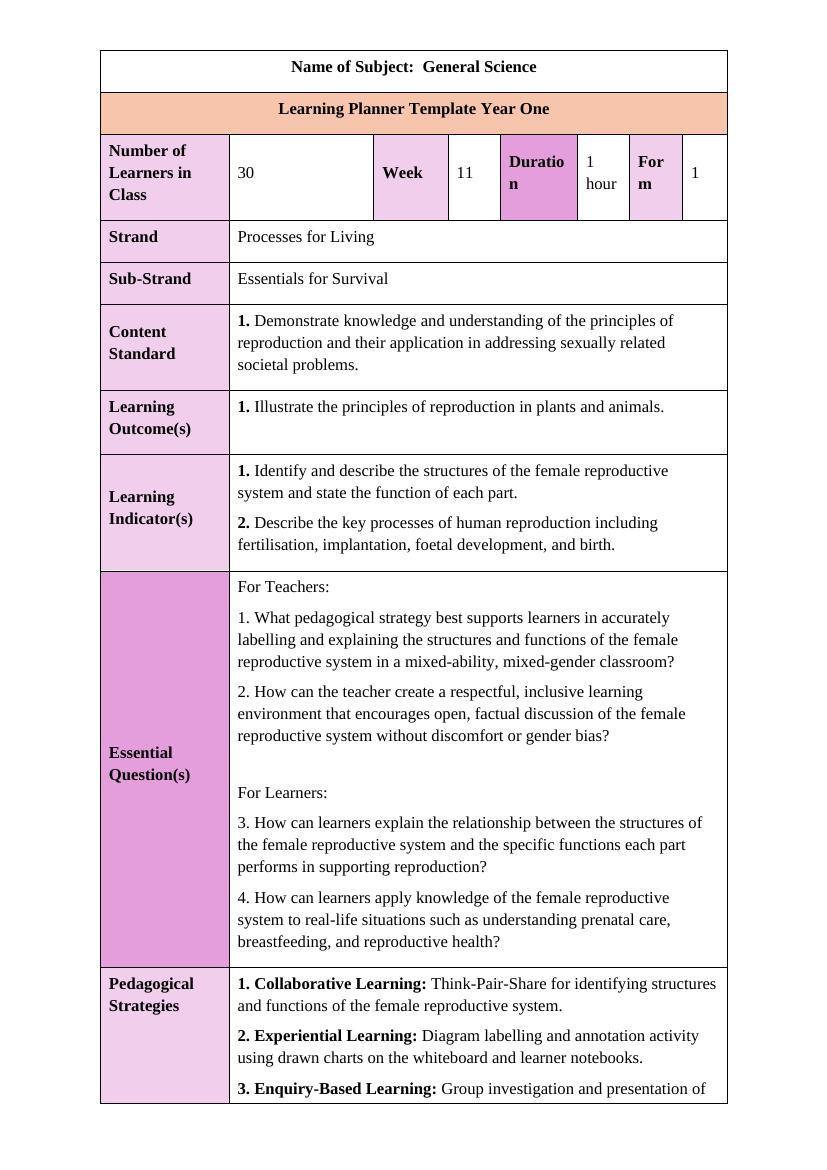
Strand, Sub-Strand & Content Standard Explained (With Examples)
The curriculum alignment section is the foundation of every NaCCA lesson plan, and it's also where most avoidable mistakes happen — wrong Strand, mismatched Sub-Strand, or a Content Standard copied from the wrong week. This guide breaks down what each term means, how they connect, and shows real examples across four subjects so you can identify them correctly every time.
1. The curriculum hierarchy
Every subject in the NaCCA Standards-Based Curriculum is organised the same way, from broadest to most specific:
- Subject — e.g. Mathematics
- Strand — e.g. Modelling with Algebra
- Sub-Strand — e.g. Number and Algebraic Patterns
- Content Standard — e.g. "Demonstrate knowledge and understanding of numbers involving the use of binary operations, sets and binomial theorem to solve problems in real life situations"
- Learning Outcomes — specific goals that support the Content Standard
- Learning Indicators — the observable, assessable evidence for each outcome
Everything in your lesson — activities, resources, and assessment — should trace back up this chain to the Content Standard.
2. What is a Strand?
A Strand is the broadest organising category in a subject — most SHS subjects have between 3 and 6. It groups related topics together and gives long-term direction to the year's teaching.
Examples by subject:
- Mathematics: Modelling with Algebra, Modelling with Geometry, Modelling with Statistics and Probability, Modelling with Trigonometry
- English Language: Listening and Speaking, Reading and Comprehension, Writing and Composition, Grammar and Language Use
- Biology: Cell and Molecular Biology, Genetics and Evolution, Ecology and Biodiversity, Human Biology and Health
- History: Ancient Civilisations, Medieval Period, Early Modern Period, Modern History
3. What is a Sub-Strand?
A Sub-Strand narrows a Strand down further — typically 2 to 4 per Strand. It's the level at which your weekly content usually sits.
Example — Mathematics, "Modelling with Algebra" Strand:
- Number and Algebraic Patterns
- Equations and Inequalities
- Functions and Relations
Example — Biology, "Cell and Molecular Biology" Strand:
- Cell Structure and Function
- Cell Division and Reproduction
- Molecular Biology
4. What is a Content Standard?
A Content Standard is a single, complete statement describing what learners should know and be able to do within a Sub-Strand. It usually has three parts:
- Action verb — Demonstrate, Develop, Apply, Analyse
- Knowledge/skill — what the verb applies to
- Context — where or how it's used, often "in real-life situations"
Example (Mathematics):
"Demonstrate knowledge and understanding of numbers involving the use of binary operations, sets and binomial theorem to solve problems in real life situations"
Broken down: Demonstrate knowledge and understanding (verb) + of numbers involving binary operations, sets and binomial theorem (knowledge/skill) + to solve problems in real life situations (context).
5. Full worked example — all levels aligned
Mathematics, Week 1, Binary Operations:
- Strand: Modelling with Algebra
- Sub-Strand: Number and Algebraic Patterns
- Content Standard: Demonstrate knowledge and understanding of numbers involving the use of binary operations, sets and binomial theorem to solve problems in real life situations
- Learning Outcomes: (a) Solve problems involving properties of binary operations (b) Model and solve real life problems on sets (c) Expand binomials with positive integral indices
- Learning Indicators: (a) Recognise binary operations and apply them to solve related problems (b) Describe commutative, associative, distributive and closure properties (c) Determine the identity element and use it to find the inverse of a given element
Notice every level narrows the one above it, and every activity or assessment task should ultimately measure one of the Learning Indicators at the bottom of this chain.
6. Common mistakes to avoid
- Paraphrasing the Content Standard — even a faithful summary is not the same as the exact curriculum wording. Copy it word-for-word.
- Using a vague Strand name — "Algebra" instead of "Modelling with Algebra."
- Writing an incomplete Content Standard — dropping the context clause ("...to solve problems in real life situations") changes what the standard is actually asking for.
- Mismatching Sub-Strand to content — always verify against your week's actual topic, not just what "sounds right."
- Copying from the wrong week — double-check the week number in the Teacher Manual before copying.
Quick reference checklist
Before finalising your curriculum alignment section, confirm:
- Strand name is copied exactly from the Teacher Manual — no shortening
- Sub-Strand matches your week's actual content, not just the Strand
- Content Standard is the complete statement, word-for-word
- Strand → Sub-Strand → Content Standard → Learning Outcomes all align with each other
Skip the manual cross-checking
SHS Planner pulls the exact Strand, Sub-Strand, and Content Standard for your subject, form, and week directly from the curriculum — matched automatically, every time.
Generate a Lesson Plan FreeFrequently Asked Questions
- What is the difference between a Strand and a Sub-Strand?
- A Strand is the broadest content category in a subject (3–6 per subject). A Sub-Strand is a narrower division within a Strand (2–4 per Strand) that focuses on a more specific area.
- Where do I find the Strand, Sub-Strand, and Content Standard for my lesson?
- In the Teacher Manual for your subject and form, organised by week. Copy them exactly as written — never paraphrase.
- Can I shorten or paraphrase the Content Standard?
- No. It should be copied word-for-word, including capitalisation and punctuation. Paraphrasing is a common reason lesson plans get flagged during supervision.
- How many Content Standards does a lesson need?
- Typically one per Sub-Strand, covering several weeks. Your weekly Learning Outcomes should each support that same Content Standard.